Search
Solartis prioritizes speed to market when implementing our platform across your Lines of Business and Programs. Afterward, maintain your products yourself with our no-code Builder Toolkit, or have Solartis maintain them for you as they change over time.
Contact Us to Learn MoreSolartis gets you to market fast, and keeps you moving long after go-live. Whatever your lines of business, our proven, AI-accelerated process takes you from kickoff to production quickly, and our support model keeps everything running once you are there. Here is how we implement, and how we support you afterward.
We implement in Agile, with your team involved at every step. Every engagement follows the same proven path, from kickoff through testing and go-live.
Project Kick-Off: Align on goals, scope, and success metrics.
Requirements Gathering: Define rules, rating, workflows, and integrations.
Agile Delivery: 2 to 4 week sprints, each ending with a demo.
Product Configuration: Configure your products early in Solartis Builder.
Governance & Communication: Daily scrums, milestone reviews, and steering-committee meetings.
Testing & Validation: QA and UAT built into every sprint.
The most important part of any implementation is getting the requirements right. We make sure both teams share the same understanding and expectations before configuration begins.
Most of your requirements come from bureau content, your state filings, and you. Our business analysts work side by side with your team to capture and document everything your Lines of Business and Programs need: the bureau content you require, your carrier-specific rates, coverages, documents and their forms, referral, underwriting and processing rules, subjectivities, and integrations. Our requirement-gathering process is proven, and it ensures every requirement is accurate and complete. For ISO programs, our structured methodology identifies exactly which ISO versions, sublines, classes of business, and coverages each program needs, so you carry only the content you use.
AI accelerates this by turning state filings and Excel rating requirement documents into Builder-ready first drafts that our team reviews, and every requirement is documented and signed off before configuration begins.
Quality is built into every sprint, not bolted on at the end. Testing runs at both the microservice and full-product level, and everything is promoted through DEV → TEST → UAT → LIVE before it reaches production.
Our teams use Solartis Builder's built-in testing tools, Selenium for automated UI regression testing, JMeter for load and performance testing, Postman for validating microservice APIs, and Excel and rule validators to confirm results against expected outcomes. AI assists by generating test scenarios and validating coverage, and we are continually expanding what it does.
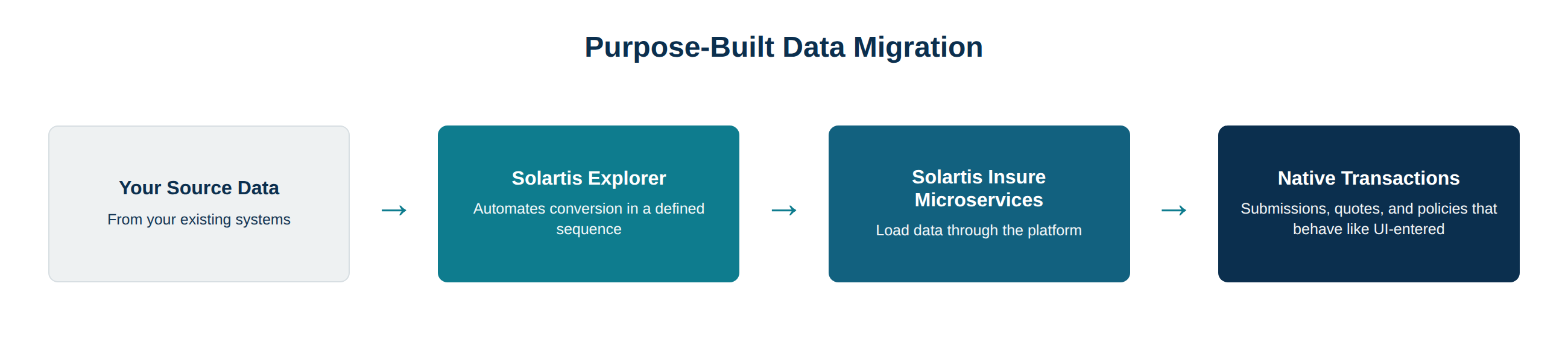
Solartis follows a purpose-built migration approach refined over more than 10 years. Using Solartis Explorer, we convert your legacy data into complete submissions, quotes, and policies, so you can endorse, renew, and service them exactly like everything else on the platform. We work with you on data quality and mapping, and scope the effort to what you need to migrate.
We take a structured, two-part approach to training and knowledge transfer, so your team is ready to run the platform.
End-User Training (Train-the-Trainer): prepares your internal team to lead rollout, delivered as a professional service with live sessions, Q&A, and custom materials.
Solartis Builder Training: hands-on training for ongoing product maintenance, including shadowing our configuration team, plus supporting materials and on-demand videos.
Together, this enables both business and technical users to manage your products independently on the Solartis platform.
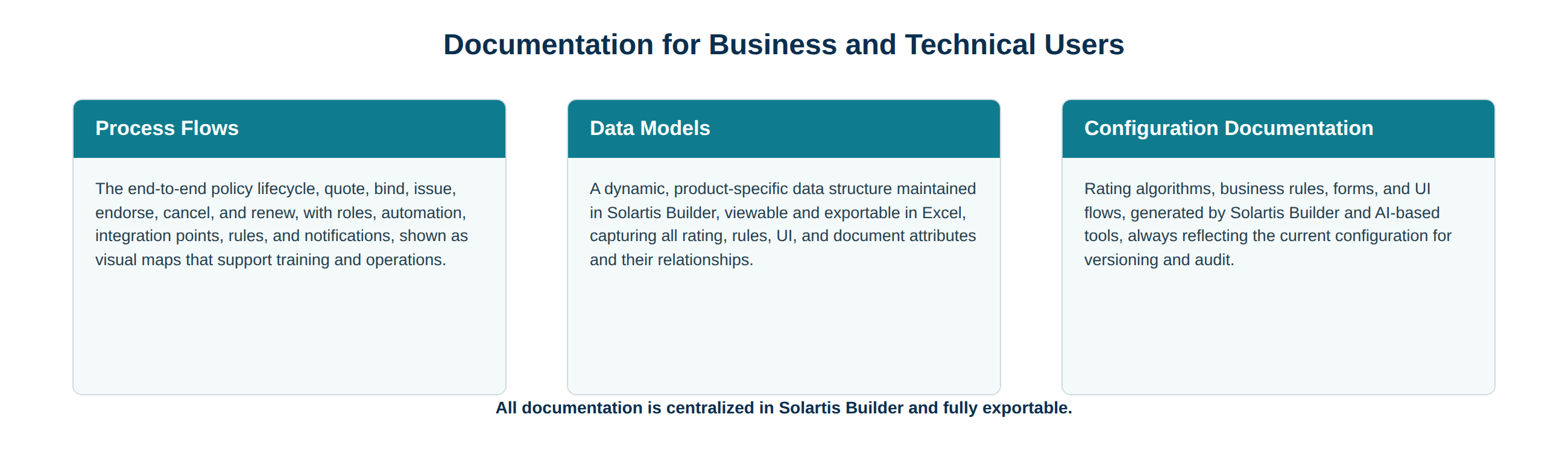
Solartis provides detailed documentation for both business and technical users, auto-generated through the configuration process.
Process Flows: the end-to-end policy lifecycle (quote, bind, issue, endorse, cancel, renew) with roles, automation, integration points, rules, and notifications, shown as visual maps.
Data Models: a dynamic, product-specific data structure maintained in Solartis Builder, viewable and exportable in Excel.
Configuration Documentation: rating algorithms, business rules, forms, and UI flows, generated by Solartis Builder and AI-based tools, always reflecting the current configuration for versioning and audit.
The full P&C policy lifecycle on one composable platform.
Configure, maintain, and test programs in a no-code toolkit.
How AI works across the platform, with people in control.
200+ microservices, deployment options, tech stack, and security.
Solartis Explorer, Your Data, Solartis Monitor, Jarvis AI, and our Monitoring Specialists.
A growing set of integrations across content providers, third-party systems, and AI tools.
With Solartis, new lines of business and programs typically launch in weeks, because Solartis Base Products already include the full policy lifecycle and bureau content. Timing depends on how much carrier-specific configuration, integration, and data migration the product needs. Work is delivered in 2 to 4 week Agile sprints, each ending with a demo.
A Solartis implementation follows the same proven path every time: project kickoff, requirements gathering, Agile delivery in sprints, product configuration in Solartis Builder, governance through daily scrums and steering committee reviews, and testing built into every sprint. Every change is promoted through DEV, TEST, UAT, and LIVE before it reaches production.
Solartis business analysts work side by side with the carrier's or MGA's team to document everything each line of business and program needs. That covers bureau content, carrier-specific rates and coverages, forms, underwriting and referral rules, subjectivities, and integrations. AI turns state filings and Excel rating requirement documents into Builder-ready first drafts that the team reviews, and every requirement is signed off before configuration begins.
ISO content is extensive, so Solartis uses a structured requirements methodology to identify exactly what each program needs. During requirements gathering, Solartis business analysts work with the customer's team to select the ISO versions, sublines, classes of business, and coverages for each program and state. The product then carries only the ISO content it uses, within the customer's ISO license.
Solartis tests every product at both the microservice and full-product level, in every sprint. Testing uses Solartis Builder's built-in tools, automated UI regression, load and performance testing, and API validation, and AI helps generate test scenarios and check coverage. Each change moves through DEV, TEST, UAT, and LIVE before reaching production.
Solartis converts legacy data into complete submissions, quotes, and policies with Solartis Explorer, so migrated business can be endorsed, renewed, and serviced like any other policy. Solartis has refined its migration approach over more than 10 years, works with each customer on data quality and mapping, and scopes the effort to what needs to move.
Solartis provides two kinds of training. Train-the-trainer end-user training, offered as a professional service, prepares the customer's team to lead the rollout. Solartis Builder training is hands-on, including shadowing the Solartis configuration team, so the customer's business and technical users can manage products on their own.
Solartis provides documentation generated through the configuration process, so it always reflects the current setup. It includes process flows for the full policy lifecycle, product-specific data models that can be exported to Excel, and configuration documentation for rating algorithms, business rules, forms, and screens.
With Solartis, customers choose. They can maintain their products themselves in the no-code Solartis Builder, or have Solartis maintain them as they change over time, as an optional professional service. Customers can also change that choice later as their team takes on more.
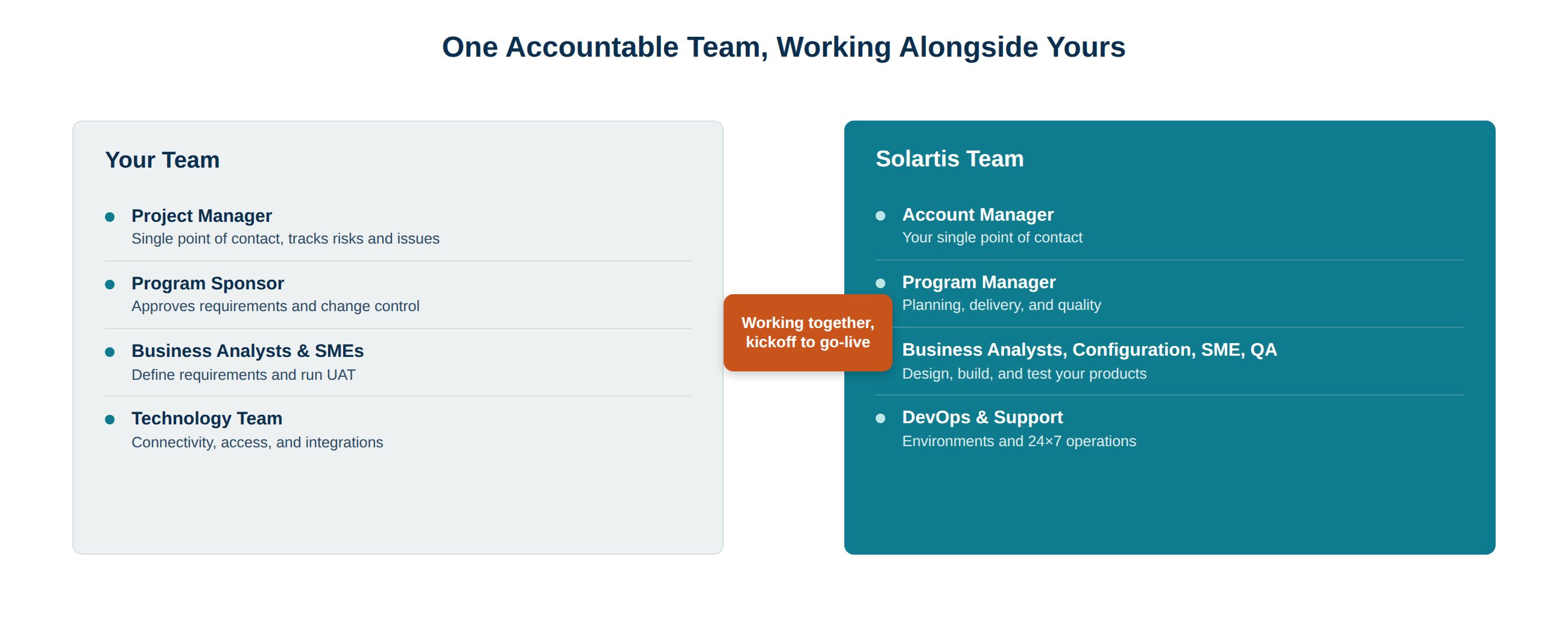
Solartis customers get a dedicated account manager, ongoing software maintenance through patch, minor, and major releases, and post-production support for usage guidance, troubleshooting, and issue resolution. Solartis Monitoring Specialists, Solartis Monitor, and Jarvis AI also watch the platform 24×7.
Solartis consumes each ISO ERC release electronically and validates it before it's available for adoption. Carrier deviations stay in their own layer, so they carry forward with each new ISO version without rebuilding the product.
Yes. Customers can start with the lines, states, and programs they need first, then add more later without rebuilding what's already live, because each new product builds on the same base configuration. For package or multi-line products, Solartis can configure the lines at the same time.