

Architecture That Lets You Change
Use Solartis as your complete policy administration platform, or introduce individual capabilities into the environment you already have.
Solartis does not require every customer to implement the platform the same way. You choose the pace and depth of modernization, and the architecture supports the model you choose.
Add capacity where a workload needs it and update capabilities without redeploying a monolith, so the platform keeps pace as your business grows.
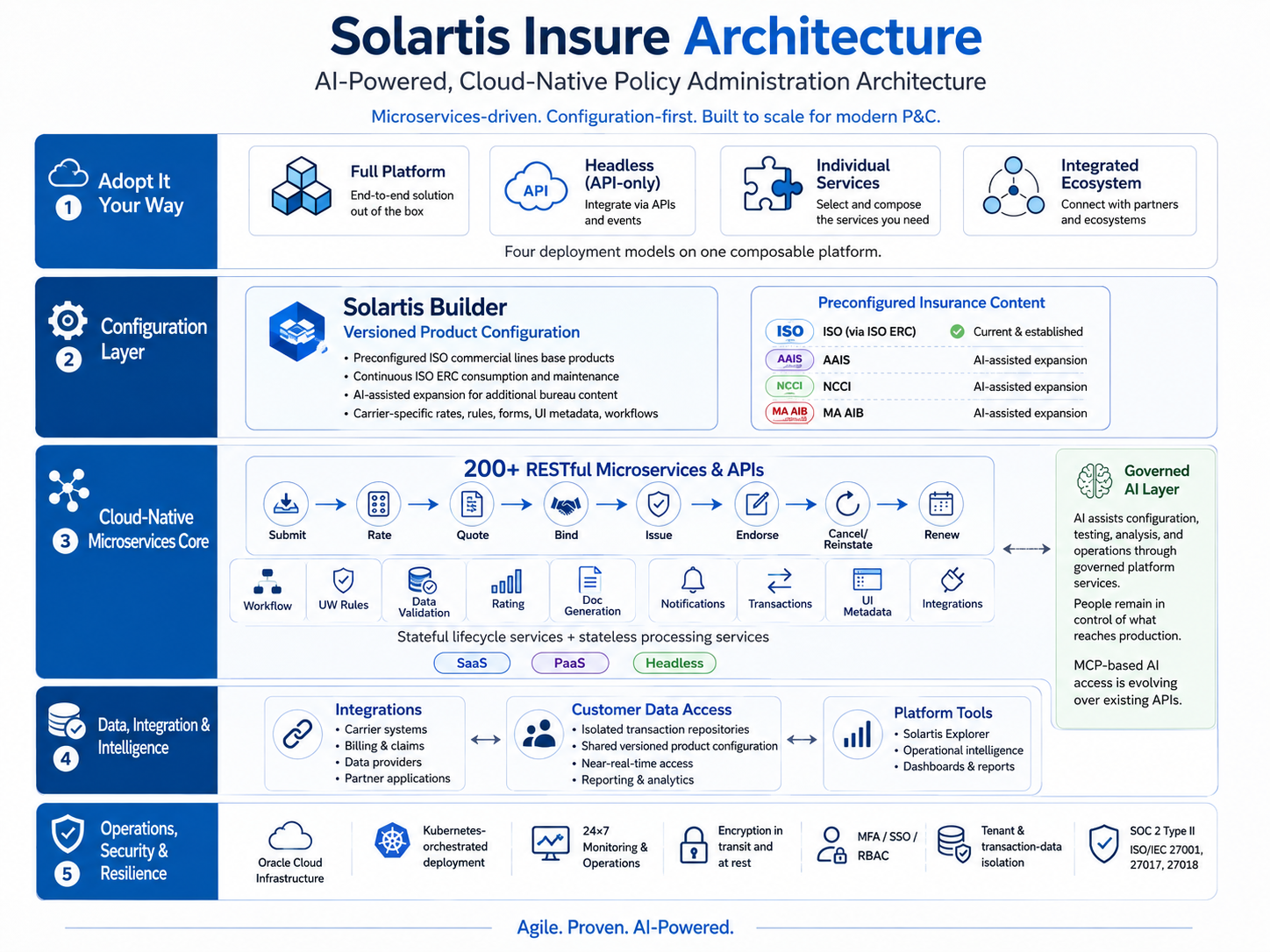
Solartis has operated a microservices architecture in production since 2016; today the platform comprises 200+ RESTful microservices and APIs across the P&C policy lifecycle. Stateful services maintain transaction context for submission, quoting, issuance, endorsements, cancellations, reinstatements, and renewals, while stateless services handle independent work such as rating, taxes and fees, document generation, and notifications. Each can scale on its own rather than forcing the whole platform to scale as one unit.
The platform is containerized and orchestrated with Kubernetes on Oracle Cloud Infrastructure, delivered as SaaS and PaaS, and API-first, and is backed by a 99.5%+ uptime SLA.
Together, microservices, API-first design, cloud-native deployment, and headless services make Solartis Insure a MACH architecture platform. Learn why MACH architecture matters in insurance →
Tech stack: Java EE, RESTful services, Kubernetes, Oracle Cloud Infrastructure.
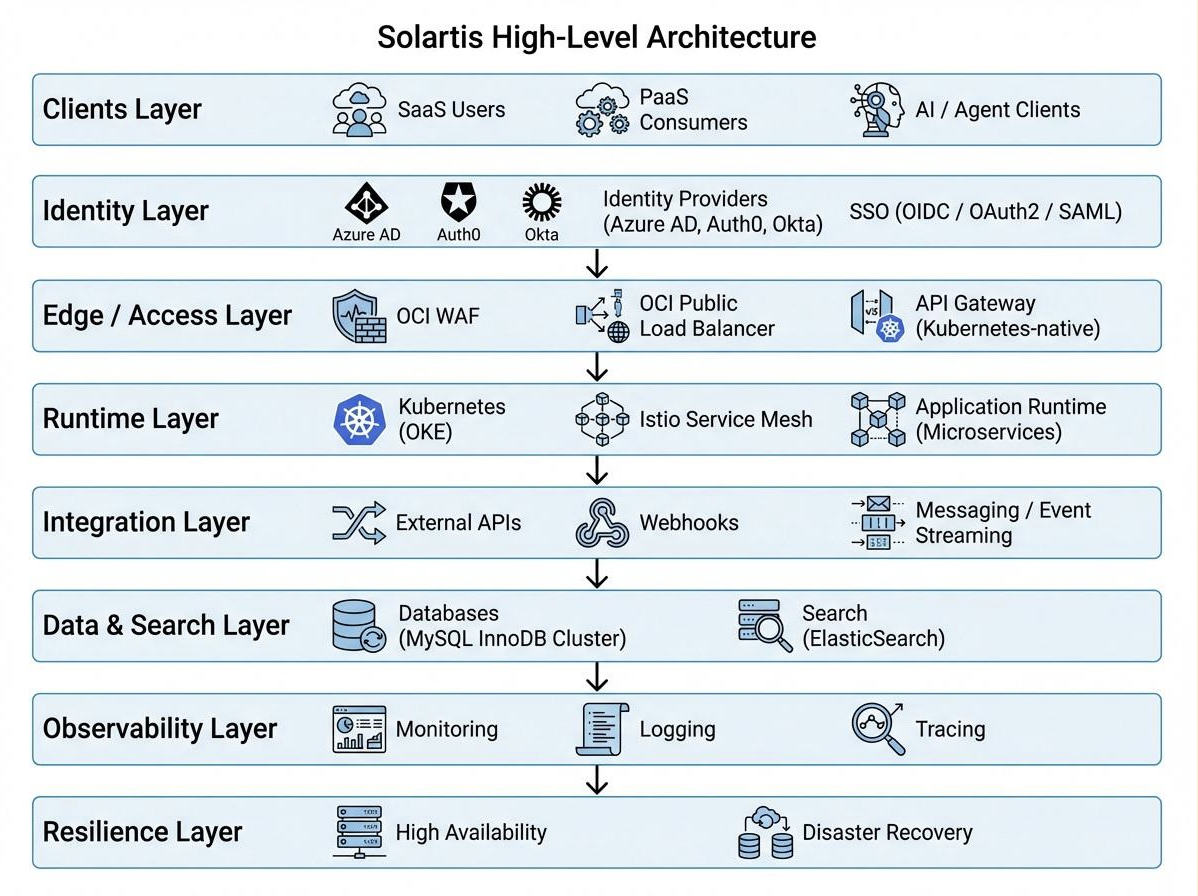
From client access through identity, edge, runtime, integration, data, observability, and resilience, Solartis runs on a consistent, cloud-native technical stack.

Solartis Insure is a cloud-native, API-first policy administration architecture built on 200+ microservices. It brings together configuration-driven product definition in Solartis Builder, preconfigured bureau content, policy lifecycle microservices, API-based integration, and governed AI, delivered as SaaS and PaaS on Oracle Cloud Infrastructure.
A microservices-based policy administration system like Solartis Insure lets each service be scaled and updated on its own, without redeploying the whole platform. Solartis has operated microservices in production since 2016, and today the platform comprises 200+ RESTful microservices and APIs across the P&C policy lifecycle.
A monolithic system runs policy administration as one application, while Solartis Insure separates it into independent services. Solartis also separates platform capability from product behavior, so each product is controlled through versioned configuration, rules, metadata, and workflows in Solartis Builder, not through custom code in a single application.
MACH stands for Microservices-based, API-first, Cloud-native, and Headless, and Solartis Insure is built on all four principles. The platform runs 200+ microservices in production, exposes its capabilities through APIs, is containerized on Kubernetes on Oracle Cloud Infrastructure, and separates business logic from the user interface. Solartis adds no-code configuration in Solartis Builder, so product changes are made through configuration, not code.
Stateful services keep the transaction context for submission, quoting, issuance, endorsements, cancellations, reinstatements, and renewals. Stateless services handle independent work such as rating, taxes and fees, document generation, and notifications. Separating the two lets each service scale on its own, instead of scaling the whole platform as one unit.
You choose how much of the platform to adopt:
No. With Solartis, insurers can start with the full platform, run Solartis headless behind their own interface, or add individual microservices to their existing systems, then expand at the pace and depth they choose.
Yes. Insurers can keep their current policy administration system and add Solartis microservices for the capabilities they need, such as rating, quoting, issuance, or document generation, for existing or new programs. The existing system connects through direct APIs, using a simple JSON request and response, or through the Solartis MCP server. The MCP server works out which microservices to call and in what order, and applies the same security and permissions as any other access.
A headless policy administration system like Solartis Insure has no screens built into its policy services, so any portal or application can call them through a simple JSON request and response. Solartis customers can also use screens configured in Solartis Builder, or connect through MCP (Model Context Protocol), one governed connection for AI tools, AI agents, and existing systems.
Solartis Insure runs on Oracle Cloud Infrastructure (OCI). The platform is containerized and orchestrated with Kubernetes, and is delivered as SaaS and PaaS.
Solartis Insure is built on Java EE and RESTful services, containerized and orchestrated with Kubernetes on Oracle Cloud Infrastructure. The technical stack covers client access, identity, edge, runtime, integration, data, observability, and resilience.
Solartis Insure is backed by a 99.5%+ uptime SLA, measured each calendar quarter, excluding regularly scheduled maintenance. Solartis Monitor, Jarvis AI, and our Monitoring Specialists watch the platform 24×7.
Older policy administration systems must scale as one unit, and Solartis Insure avoids that, because each microservice scales on its own and capacity is added where a workload needs it. Kubernetes on Oracle Cloud Infrastructure manages that capacity, and capabilities can be updated without redeploying a monolith.
In one defined Solartis performance test, a multi-state commercial auto schedule of 10,000 vehicles was processed from vehicle import through rating, quote, and policy issuance in under five minutes. Testing runs complete policy workflows, not isolated API calls. Results vary with product configuration, infrastructure, transaction complexity, integrations, and workload.
In a configuration-driven policy administration system like Solartis Insure, reusable microservices provide the capabilities and versioned configuration defines each product. Solartis Builder holds that effective-dated configuration, products start from preconfigured bureau Base Products that contain the full policy lifecycle, and carrier-specific rates, rules, forms, and exceptions are layered on top. Changing a product means changing configuration, not code.
Each customer's policy transactions are held in isolated repositories rather than a shared transaction database. Product configuration is shared and versioned separately, which supports auditability across the policy lifecycle.
Security controls apply across the application, integration, data, cloud, and AI layers, including encryption in transit and at rest, role-based access control, MFA and SSO, tenant and transaction-data isolation, audit logging, independent penetration testing, and network and infrastructure controls. Solartis holds SOC 2 Type II, ISO/IEC 27001:2022, ISO/IEC 27017:2015, and ISO/IEC 27018:2019 certifications.
AI works through the same governed platform services, configuration, and APIs as everything else, so identity, authorization, data classification, and audit controls still apply. It is not a separate path around the policy services or business rules. When your AI tools, AI agents, or existing systems connect through MCP, the Solartis MCP server applies the same security and permissions as any other access. AI accelerates the work, and people remain in control of what reaches production.
Solartis Insure is built on 200+ API-first microservices, so carriers and MGAs can connect third-party data, bureau content, carrier systems, and AI tools without tightly coupling them to the core platform. Integrations use REST/JSON APIs, event-driven messaging, secure batch and file exchange, or MCP, and are configured to match each customer's business processes and security requirements.

