SOLARTIS INSURE · TECHNOLOGY & ARCHITECTURE

AI-Powered, Cloud-Native Policy Administration Architecture

Microservices-driven. Configuration-first. Built to scale for modern P&C.

Request a Walkthrough

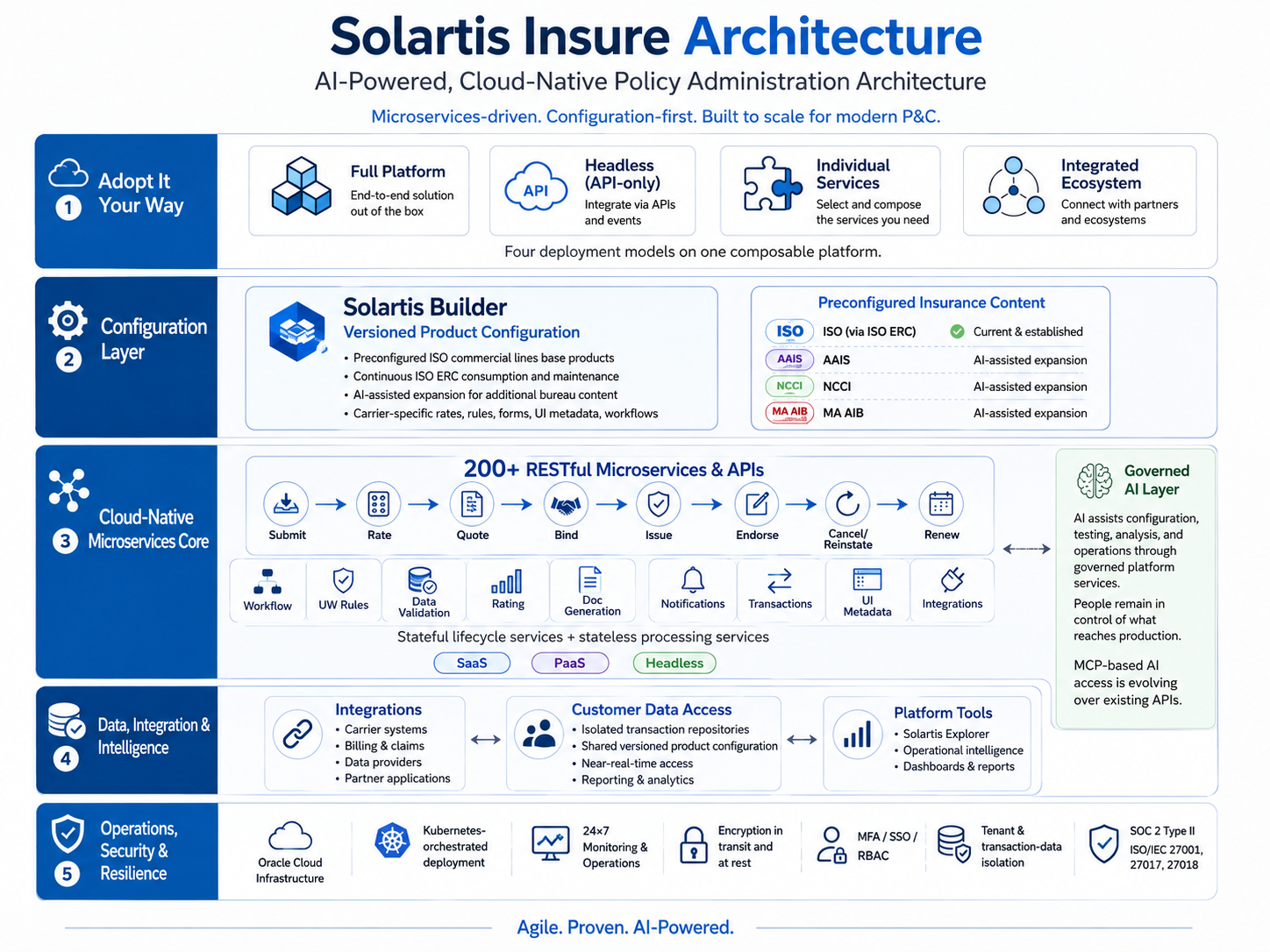
Solartis Insure brings configuration-driven product definition, preconfigured bureau content, policy-lifecycle microservices, API-based integration, cloud-native deployment, and a governed AI layer together in one architecture. Adopt it your way: run the complete platform, use Solartis services headless behind your own experience, or add selected microservices to the systems you already run.

Solartis Insure Architecture

Take a deeper look at our AI-powered, cloud-native policy administration architecture.

It includes deployment models, a cloud-native microservices core, configuration-driven insurance content, and enterprise security in one architecture.

Solartis Insure Architecture - AI-Powered Cloud Native-PAS


Adopt It Your Way

Solartis does not require every customer to implement the platform the same way. You choose the pace and depth of modernization, and the architecture supports the model you choose.

  • Full Platform: Run the complete P&C policy lifecycle on Solartis Insure, with a Solartis-configured UI managed in Builder.
  • Headless (API-only): Run Solartis policy services and APIs behind your own digital experience.
  • Individual Services: Adopt selected capabilities, such as rating or document services, alongside the systems you already run.
  • Integrated Ecosystem: Combine Solartis with carrier systems, data providers, billing, claims, and partner applications.


A Cloud-Native Microservices Core

Add capacity where a workload needs it and update capabilities without redeploying a monolith, so the platform keeps pace as your business grows.

Solartis has operated a microservices architecture in production since 2016; today the platform comprises 200+ RESTful microservices and APIs across the P&C policy lifecycle. Stateful services maintain transaction context for submission, quoting, issuance, endorsements, cancellations, reinstatements, and renewals, while stateless services handle independent work such as rating, taxes and fees, document generation, and notifications. Each can scale on its own rather than forcing the whole platform to scale as one unit.

The platform is containerized and orchestrated with Kubernetes on Oracle Cloud Infrastructure, delivered as SaaS and PaaS, and API-first, and is backed by a 99.5%+ uptime SLA.

Tech stack: Java EE, RESTful services, Kubernetes, Oracle Cloud Infrastructure.


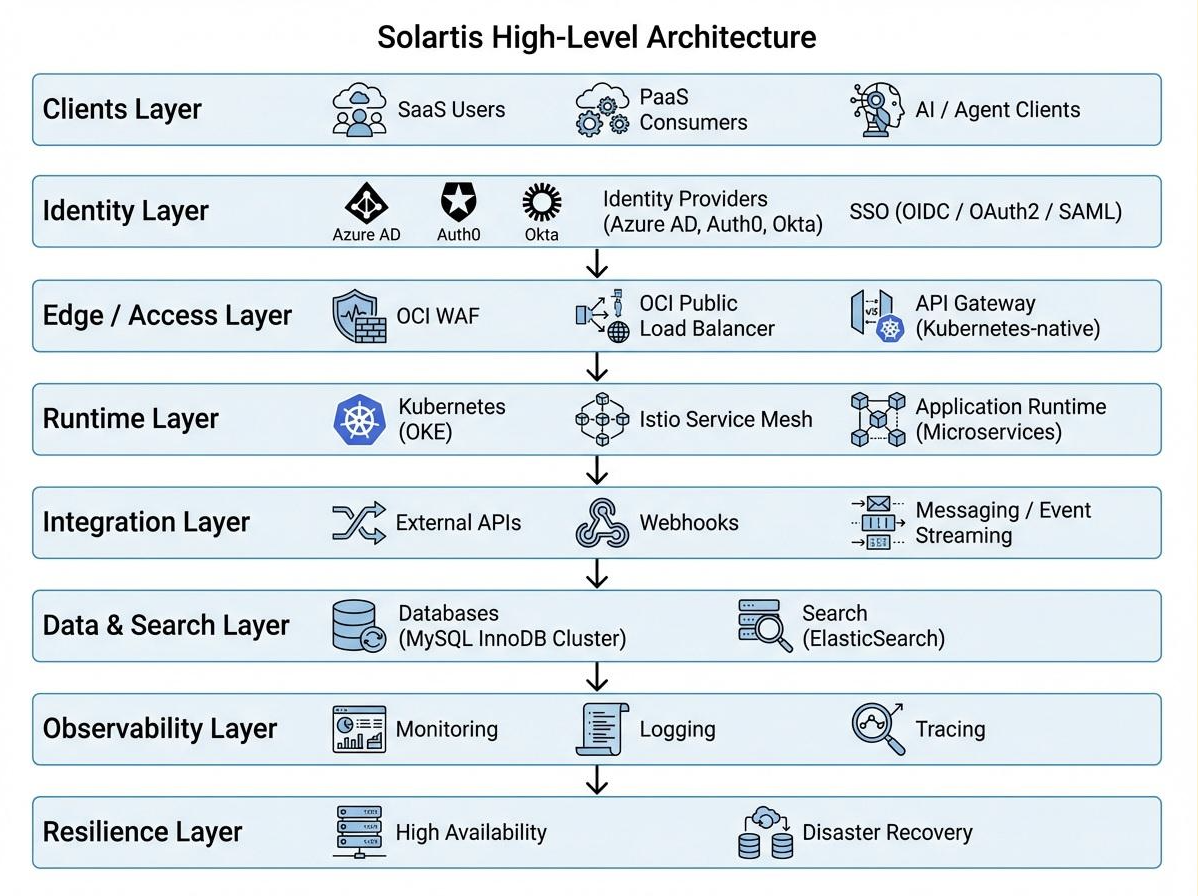
The Technical Stack

From client access through identity, edge, runtime, integration, data, observability, and resilience, Solartis runs on a consistent, cloud-native technical stack.

Screenshot 2026-09-18 at 6.00.15 PM

Designed for Control, Scale, and Connectivity

Configuration-Driven, by Design

The architecture separates platform capability from insurance product behavior. Reusable services provide the policy administration capabilities; Solartis Builder is the system of record for the versioned, effective-dated configuration those services run at runtime.  Implementation teams start with preconfigured bureau base products that contain the full policy lifecycle, then layer carrier-specific rates, rules, forms, and exceptions on top.

ISO content is ingested and maintained through ISO ERC. AI assists the ingestion of AAIS, NCCI, and MA AIB (Mass Auto) content.


→ Explore Solartis Builder

AI, Governed by Design

AI is embedded across the platform to analyze requirements and content, generate rating configuration, create and validate tests, and monitor production. It works through the same governed platform services, configuration, and APIs as everything else, so identity, authorization, data classification, and auditability continue to apply. It is not a separate path around the policy services or business rules.

AI accelerates the work. People remain in control of what reaches production.

→  Explore Solartis' AI Capabilities

Proven Performance at Scale

Solartis performance testing runs complete policy workflows against large commercial schedules, not isolated API calls. In one defined commercial auto scenario, Solartis processed a multi-state schedule of 10,000 vehicles from vehicle import through rating, quote, and policy issuance in under five minutes.

Customer transaction data is held in isolated repositories rather than a shared transaction database, while product configuration is shared and versioned, which supports auditability across the policy lifecycle.

Results reflect a defined Solartis performance test scenario. Performance varies with product configuration, infrastructure, transaction complexity, integrations, and workload.

Enterprise Security & Data Isolation

Security controls apply across the application, integration, data, cloud, and AI layers of the Solartis environment: encryption in transit and at rest, role-based access control, MFA and SSO, tenant and transaction-data isolation, audit logging, independent penetration testing, network and infrastructure controls, and governed access to AI capabilities.

Certifications: SOC 2 Type II, ISO/IEC 27001:2022, ISO/IEC 27017:2015, ISO/IEC 27018:2019.

→  Full Security & Compliance Program

Connect to the Ecosystem You Already Have

Solartis is API-first and designed to operate inside a broader insurance technology environment. It integrates with distribution and underwriting systems, rating and data providers, document and e-signature tools, payment, billing and claims platforms, regulatory and statistical services, analytics environments, and your own applications.

→  Explore Our Integration Ecosystem

Architecture That Lets You Change

Use Solartis as your complete policy administration platform, or introduce individual capabilities into the environment you already have.
Frequently Asked Questions

1. Is Solartis Insure a microservices-based platform?

Yes. Solartis uses 200+ RESTful microservices and APIs across the P&C policy lifecycle, including stateful policy-lifecycle services and stateless processing services.

2. Is Solartis a monolithic policy administration system?

No. Solartis separates policy administration into services, and separates platform functionality from insurance product configuration. Product-specific behavior is controlled through versioned configuration, rules, metadata, and workflows.

3. Do we have to implement the entire Solartis platform?

No. Solartis can run as a complete policy administration platform, as headless services behind your own digital experience, or as selected services integrated with your existing systems.

4. Can we use our own user interface?

Yes. Solartis policy administration services are separated from the user interface, so you can run Solartis APIs and metadata services behind your own digital experience.

5. How is customer transaction data isolated?

Solartis separates shared product configuration from customer transaction data. Each customer's policy transactions are maintained in isolated repositories.

Schedule Time With Us!

Connect with our experts for a demonstration of our Solartis Insure Platform and our AI capabilities.